
TL;DR:
- Payroll outsourcing assigns third-party providers to manage wage calculations, taxes, filings, and employee payments globally. It lowers costs, minimizes compliance risks, and ensures local legal adherence through expert oversight and system integrations. Businesses should treat outsourcing as an ongoing partnership, with clear controls and local expertise to maximize its benefits.
Payroll outsourcing is defined as the practice of delegating your company’s payroll administration to a third-party specialist who handles wage calculation, tax withholding, statutory filings, and employee payments on your behalf. For international businesses entering new markets, this model replaces the need to build costly in-house payroll expertise from scratch. Employers can reduce payroll-related costs by an average of 18% through outsourcing, primarily by cutting administrative overhead and avoiding compliance penalties. That figure alone makes the business case clear before you hire your first overseas employee.
What does payroll outsourcing actually cover?
Payroll outsourcing goes well beyond cutting checks. A full-service provider manages the entire payroll cycle: collecting hours and compensation data, calculating gross and net wages, applying the correct tax withholding rates, processing statutory deductions, and transferring funds to employee accounts on schedule. The provider also handles employer-side filings with tax authorities and social security agencies in each jurisdiction where you operate.
Most providers also include these services within a standard engagement:
- Year-end tax reporting: Preparation and submission of annual employee tax documents required by local law
- Compliance monitoring: Automatic updates when tax codes, minimum wage rates, or social contribution rules change
- Employee self-service portals: Digital access for workers to view pay stubs, tax documents, and leave balances
- Multi-currency payroll: Processing wages in local currencies across multiple countries from a single platform
- Statutory benefit administration: Calculation and remittance of pension contributions, health insurance, and other mandated benefits
The critical distinction between payroll outsourcing and payroll software is expert oversight. Software automates calculations but leaves filing, compliance interpretation, and error resolution to your internal team. Outsourcing transfers that execution responsibility to specialists who do this work daily across multiple jurisdictions. For a company entering Portugal or another EU market for the first time, that difference is significant. You can read more about managing international payroll in Portugal to understand what local compliance actually demands.
Pro Tip: Start with a full-service engagement for your first international market. Once you understand local payroll requirements, you can negotiate a narrower scope if your volume justifies it.

How does payroll outsourcing reduce costs and risk?
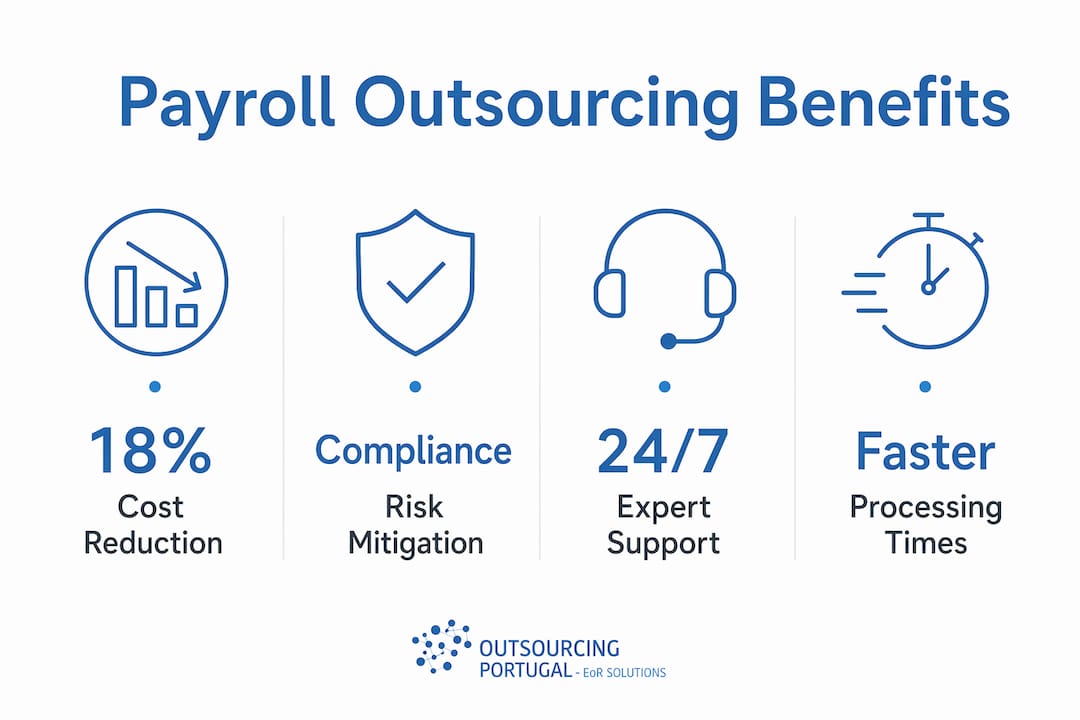
The financial case for outsourcing payroll rests on two pillars: lower operating costs and reduced penalty exposure. Basic payroll processing starts under $100 per month, with per-employee fees typically ranging from $2–$5 monthly for comprehensive solutions. That pricing model is almost always cheaper than the fully loaded cost of an internal payroll specialist, especially when you factor in software licenses, training, and the time your HR or finance team spends on compliance research.
The risk reduction argument is equally strong. 78% of employees would face significant financial difficulty if their paycheck were delayed by just one week. That statistic reframes payroll accuracy as an employee retention issue, not just an administrative one. A single missed payroll cycle in a new market can damage trust with your local workforce before your operation gains traction.
Outsourcing payroll mitigates compliance drift by keeping your payroll automatically aligned with local tax code updates. When Portugal revises its IRS withholding tables or the EU adjusts social contribution rules, your provider absorbs that change. Your team does not need to monitor it.
The table below summarizes the core financial and operational benefits:
| Benefit | What it means in practice |
|---|---|
| 18% average cost reduction | Lower overhead from eliminating internal payroll administration |
| Penalty avoidance | Specialists catch filing errors before tax authorities do |
| Predictable pricing | Per-employee fees make budgeting straightforward as headcount grows |
| Compliance currency | Tax code changes are applied automatically without internal research |
Pro Tip: Ask any provider to show you their error rate and penalty history across their client base. A reputable firm will share this data. One that refuses is telling you something important.
What are the key challenges of international payroll outsourcing?
Outsourcing payroll internationally introduces challenges that go beyond the domestic version of the same decision. The most important one is legal: employers remain legally responsible for payroll accuracy and tax deadlines even after outsourcing. The provider executes the work, but the liability stays with you. That means you need internal controls to verify what your provider submits, not just trust that it is correct.
The second major challenge is system integration. A lack of integration between time-tracking and payroll systems leads to manual data reconciliation and the errors that come with it. If your HR platform does not connect directly to your provider’s system, someone on your team manually transfers hours, leave balances, and compensation changes every pay cycle. That manual step is where mistakes happen.
Here are the most common implementation challenges international businesses face:
- Data migration accuracy: Historical payroll records, employee classifications, and tax IDs must transfer without gaps
- Parallel run requirements: Switching providers requires parallel payroll runs and extensive data reconciliation to catch discrepancies before going live
- Year-end timing: Transitioning mid-year creates reporting complexity, since annual tax documents must reflect the full calendar year
- Local expertise gaps: A provider with strong US or UK operations may lack depth in Portuguese labor law or EU social security rules
- Customization limits: Standardized service packages may not accommodate your specific bonus structures, commission calculations, or equity compensation
When selecting a provider for Portugal or another EU market, verify their local legal team’s credentials. Ask specifically whether they employ licensed tax advisors in the target country, not just regional generalists. Outsourcing-portugal works with providers who hold in-country expertise across Portuguese employment law, which matters when edge cases arise.
The numbered steps below outline a sound implementation sequence:
- Audit your current payroll data for accuracy and completeness before any migration begins
- Map your HR and time-tracking systems to confirm API or file-based integration is available
- Run parallel payrolls for at least two full cycles before decommissioning your previous system
- Assign an internal owner to review provider outputs each pay period and flag discrepancies
- Establish an escalation path with your provider for urgent compliance questions
How do you choose the right payroll outsourcing provider?
Provider selection determines whether outsourcing delivers its promised benefits or creates new problems. The evaluation criteria that matter most for international businesses differ from those relevant to domestic companies.
Jurisdiction expertise is the first filter. A provider must demonstrate direct experience with the tax codes, labor laws, and filing requirements of every country where you employ people. Generic claims of “global coverage” are not sufficient. Ask for a client reference in your target market and verify that the reference operates under similar employment structures to yours.
Technology platform quality is the second filter. The right platform offers cloud-based access, automated tax table updates, and direct API integration with major HR systems like Workday, BambooHR, or SAP SuccessFactors. Security certifications matter too. Look for SOC 2 Type II compliance or equivalent, which confirms the provider has audited controls over your payroll data. You can also explore payroll services in Portugal to understand what a well-structured local engagement looks like.
Key evaluation criteria to apply during provider selection:
- Scope flexibility: Businesses can outsource only high-risk compliance tasks initially while retaining simpler processing in-house. Confirm your provider supports partial outsourcing if that fits your current stage.
- Support responsiveness: Payroll errors are time-sensitive. Your provider must offer same-day escalation for critical issues, not a 48-hour ticket queue.
- Reporting and analytics: Monthly payroll reports should include cost-per-employee breakdowns, variance analysis, and compliance status by jurisdiction.
- Scalability: Confirm the provider can handle your projected headcount growth without renegotiating the entire contract.
- Transparent pricing: Request a full fee schedule including setup fees, per-run charges, and costs for off-cycle payrolls.
For businesses exploring payroll solutions across multiple European markets, payrolling via NOWJOBS offers a practical model worth reviewing alongside your other options.
Pro Tip: Negotiate a service-level agreement that specifies maximum processing times, error correction windows, and financial remedies if the provider misses a filing deadline. Without it, you have no recourse when something goes wrong.
Key Takeaways
Payroll outsourcing reduces costs, eliminates compliance drift, and frees international businesses to focus on growth rather than administrative execution.
| Point | Details |
|---|---|
| Average cost reduction | Outsourcing cuts payroll overhead by an average of 18%, primarily through fewer penalties and lower staffing costs. |
| Legal liability stays with you | Employers remain responsible for accuracy and tax deadlines regardless of who processes the payroll. |
| Integration is non-negotiable | Connecting HR and time-tracking systems to your provider eliminates manual reconciliation errors. |
| Partial outsourcing is valid | Starting with high-risk compliance tasks only gives you control while reducing your most costly exposure. |
| Local expertise matters most | Providers must hold in-country knowledge of labor law, not just regional generalist coverage. |
What I’ve learned about payroll outsourcing after years of watching companies get it wrong
The most common mistake I see international businesses make is treating payroll outsourcing as a set-and-forget decision. They sign a contract, hand over their data, and assume the problem is solved. Six months later, they discover their provider has been applying the wrong social contribution rate, and the liability has been accumulating the entire time.
The businesses that get the most value from outsourcing treat it as a working partnership. They assign an internal payroll owner who reviews every output before it is finalized. They schedule quarterly reviews with their provider to discuss regulatory changes, headcount shifts, and upcoming compliance deadlines. They ask for data, not just assurances.
The second thing I have learned is that the onboarding phase is where most problems originate. Providers often underestimate the complexity of a client’s existing payroll data, and clients often overestimate how clean their records are. A parallel run period is not optional. It is the only way to catch discrepancies before they become penalties.
My honest recommendation: before you sign with any provider, ask them to walk you through a real compliance failure they experienced with a client and how they resolved it. A provider who has never made a mistake either has not been doing this long enough or is not being honest with you. The ones who can describe a failure clearly and explain what they changed afterward are the ones worth trusting.
Payroll data also contains your most granular workforce cost information. The businesses using it well are running monthly cost-per-department analyses and feeding that data into hiring decisions. Most businesses are not doing this. That gap is a real competitive advantage waiting to be used.
— Paulo
Payroll and employment solutions for international businesses entering new markets
International businesses entering Portugal or other EU markets face a specific challenge: they need payroll compliance from day one, but they do not yet have the local knowledge to verify what “compliant” actually means in practice.
Outsourcing-portugal works with international companies at exactly this stage. The platform connects businesses with vetted employment and payroll specialists who hold in-country expertise across Portuguese labor law, tax filings, and EU compliance requirements. Whether you need a full Employer of Record arrangement or targeted payroll support, the right structure depends on your headcount, timeline, and risk tolerance. The best employment outsourcing services for 2026 page outlines the top-rated agencies currently serving international clients in Portugal, with transparent scope descriptions to help you compare options. You can also review the full range of payroll and employment services available through the platform.
FAQ
What is payroll outsourcing?
Payroll outsourcing is the practice of hiring a third-party provider to manage payroll functions including wage calculation, tax withholding, statutory filings, and employee payments. It replaces the need for an internal payroll team and provides access to specialized compliance expertise.
How much does payroll outsourcing cost?
Basic payroll processing starts under $100 per month, with per-employee fees ranging from $2–$5 monthly for comprehensive services. Total cost depends on headcount, the number of jurisdictions covered, and the scope of compliance services included.
Does outsourcing payroll remove my legal liability?
No. Employers remain legally responsible for payroll accuracy and tax deadline compliance even after outsourcing. The provider executes the work, but the legal obligation stays with your company.
What is the role of payroll management in international expansion?
Payroll management handles the calculation, payment, and reporting of employee compensation in compliance with local labor and tax law. For international businesses, accurate payroll management is the foundation of legal employment in any new market.
Can I outsource only part of my payroll process?
Yes. Businesses can outsource only high-risk compliance tasks initially while retaining simpler processing in-house. This phased approach gives you control over the transition and reduces your most costly compliance exposure first.