

A cláusula de não concorrência is only valid in Portugal when three conditions line up: it’s in writing, it protects against a real risk of prejudice to the employer, and the employer pays compensation for the restricted period. Miss any one of the three and the clause is void, full stop. The maximum duration is two years, stretched to three only for roles built on special trust or access to sensitive information.
That’s the legal skeleton. The details, though, decide whether your specific clause survives a labor court.
- Written agreement, signed by both parties, in the employment contract or a later agreement
- Genuine risk that the employee’s future activity could damage the employer
- Compensation paid throughout the restriction, calculated in a determinable way
Pro tip: If your clause bans “any activity in the sector” across all of Portugal for three years with no pay formula, treat that as a warning sign. Courts routinely trim or annul language that broad.
Under Article 136.º of the Código do Trabalho, the standard cap is two years, extended to three years for positions involving special trust or access to particularly sensitive technical or commercial information.
TL;DR:
- Non-compete clauses must be in writing, protect against a real risk of harm, and include determinable compensation; missing any condition renders them invalid.
- Duration is capped at two years generally, with a possible extension to three years only for roles involving trust or access to sensitive information.
- Courts scrutinize whether the compensation is objectively calculable and the scope matches the company’s actual business footprint, often reducing overly broad or vague clauses.
- Compensation formulas must be clear, either fixed percentages, flat rates, or a combination, to withstand judicial review, especially if a dismissal is illicit.
- Employers should tailor clauses to specific roles and geographic areas, avoiding blanket bans, to avoid annulment or reduction by courts.
Table of Contents
- What Article 136.º Actually Says About Non-Compete Agreements
- How Portuguese Courts Actually Test These Clauses
- Getting Compensation Right: Formulas, Fairness, and the Illicit Dismissal Rule
- Scope, Territory, and Duration: Where Clauses Go Too Far
- What Happens When a Non-Compete Clause Is Breached
- A Working Checklist for Employers and Employees
- How Outsourcing-Portugal Helps Employers Get This Right
- The Gap Between the Statute and What Actually Gets Litigated
- Key Takeaways
- Sources
What Article 136.º Actually Says About Non-Compete Agreements
Article 136.º opens with a blunt rule: clauses restricting a worker’s freedom to work after the contract ends are null. That’s the default position under Portuguese labor law. It then carves out an exception, and everything in this article hangs on that exception.
Number 2 of the article allows a non-compete agreement, but only if three cumulative conditions are met:
- The agreement is in writing, whether in the original contract or a separate document
- The employee’s role or knowledge means future competing activity could genuinely harm the employer
- The employer pays compensation during the restriction, with the two or three year cap depending on the role’s level of trust
The written form has to appear where the obligation is created. That usually means the employment contract itself, but it can also sit in a termination agreement negotiated when the relationship ends. A verbal understanding, or a clause referenced only in an internal policy the employee never signed, won’t hold up. Government legal databases and official statute portals confirm this structure hasn’t changed in recent reforms, so employers drafting contracts in 2026 are working from the same framework that’s applied for years.
How Portuguese Courts Actually Test These Clauses
Judges don’t take an employer’s word for it that competition would cause harm. They look for what legal commentary calls concorrência diferencial, meaning competition specific enough, and damaging enough, to justify restricting someone’s right to work. Ordinary competition, the kind that exists in any market, isn’t enough on its own.
The compensation must be determinable: if the contract doesn’t fix an exact value, it needs objective criteria that let a court calculate it later. Without that, the clause risks annulment and the employer may have to return sums already paid.
That determinability rule, drawn from a Tribunal da Relação do Porto ruling, trips up more clauses than any other single defect. Common patterns in judicial decisions include:
- Vague promises to “negotiate compensation later” treated as no compensation clause at all
- Geographic bans covering the whole country when the employer only operates in one region
- Clauses reduced in scope rather than struck down entirely, when the defect is proportionality rather than a missing element
Getting Compensation Right: Formulas, Fairness, and the Illicit Dismissal Rule
Portuguese law sets no fixed minimum for non-compete pay. What it demands is that the amount be determinable and proportionate to the restriction placed on the worker. Employers have a few workable options:
- A fixed percentage of the employee’s base salary, paid monthly for the restriction period
- A flat monthly complement stated in euros, adjusted for inflation if the contract says so
- A mixed formula combining a base percentage with a guaranteed minimum, often paired with an offset clause reducing payment if the former employee earns income elsewhere
Courts accept variable monthly payments as long as the formula is objective enough that anyone could calculate the exact figure without further negotiation. What they reject is ambiguity dressed up as flexibility.
One wrinkle catches employers off guard: when a dismissal is declared illicit, or the employer is otherwise at fault for ending the contract, compensation can be raised up to the worker’s full base salary for the restricted period, even if the original clause specified a lower amount.
Scope, Territory, and Duration: Where Clauses Go Too Far

Two years is the working default. Three years applies narrowly, to roles genuinely built on trust or exposure to sensitive commercial information, not to every mid-level manager an employer wants to lock down longer.
Geography is where a lot of clauses fail in practice. A company operating only in Lisbon and Porto has a hard time justifying a nationwide ban, and an even harder time justifying one that reaches beyond Portugal. Legal commentary on restrictive covenant proportionality is consistent on this point: the restriction has to match the actual footprint of the business it’s protecting.
- Tie the restriction to specific roles, products, or named clients rather than “any activity in the sector”
- Match geographic scope to where the employer genuinely competes, not an aspirational future market
- Reserve the three-year window for roles with documented access to trade secrets or strategic client relationships
Pro tip: Draft the activity restriction as a list of competing functions or named competitors, not a broad industry label. Courts read specificity as evidence the clause targets a real risk, not a blanket attempt to sideline a former employee.
What Happens When a Non-Compete Clause Is Breached
When an employer believes a former employee has violated a valid pact, the usual remedies are repayment of compensation already received, a contractual penalty if one was written into the agreement, and damages tied to actual harm. Courts don’t award these automatically. They expect proof.
- Evidence of actual client contact, use of confidential information, or direct solicitation carries far more weight than the mere fact that the former employee took a job with a competitor
- Employers seeking urgent relief, such as an injunction to stop ongoing harm, need to move quickly and document the breach as it happens
- Both sides should preserve records: emails, client lists, contracts with the new employer, and payment history under the pact
Settlement is common in these disputes because litigation is slow and outcomes hinge heavily on how well the original clause was drafted. A pact with vague scope or undetermined compensation gives the employee a strong defense before the breach question is even reached.
A Working Checklist for Employers and Employees
Employers drafting a cláusula de não concorrência should document the specific legitimate interest at stake, keep the scope narrow, build in an objective compensation formula, and retain records of any training or client relationships the clause is meant to protect.
Employees asked to sign one should confirm the written form covers the whole obligation, check that compensation is determinable rather than promised in vague terms, and get any verbal assurances put in writing before signing.
- Employers: match clause scope to actual business footprint, not aspirational reach
- Employees: ask what happens to compensation if you’re dismissed rather than resigning
- Both sides: keep a signed copy and any amendments in one place, not scattered across email threads
Pro tip: International employers hiring in Portugal without a local HR team often get this wrong not through bad faith, but because payroll systems abroad aren’t built to track ongoing post-employment payments. That’s exactly the kind of detail a local employer of record catches before it becomes a dispute.
How Outsourcing-Portugal Helps Employers Get This Right
International companies hiring in Portugal often draft non-compete clauses using templates built for a different legal system, then discover the compensation formula doesn’t meet Portuguese determinability standards. Outsourcing-portugal handles this at the source, through contract review, payroll administration for compensatory payments, and ongoing legal compliance support.
- Contract review that flags overbroad scope or undetermined compensation before signing
- Compensatory payments processed and documented through payroll, not tracked manually offshore
- Centralized record-keeping for contract amendments and termination agreements
- Local HR support for questions that arise mid restriction period
Running compensation through an Employer of Record in Portugal means payments are taxed correctly and timestamped automatically, which matters if a dispute ever reaches a labor court. For companies building or expanding a team in Portugal without a local entity, this kind of structure removes the guesswork around Article 136.º compliance. Explore Outsourcing-portugal’s hiring services to see how contract and payroll support fits your situation.
The Gap Between the Statute and What Actually Gets Litigated
Most guidance on this topic stops at reciting Article 136.º and calling it done. That misses where the real disputes happen. The statute’s three conditions are easy to state and easy to draft around on paper. The fights in court are almost never about whether a clause exists in writing. They’re about whether the compensation formula was specific enough to calculate, and whether the scope matched a real business interest instead of a generic fear of competition.
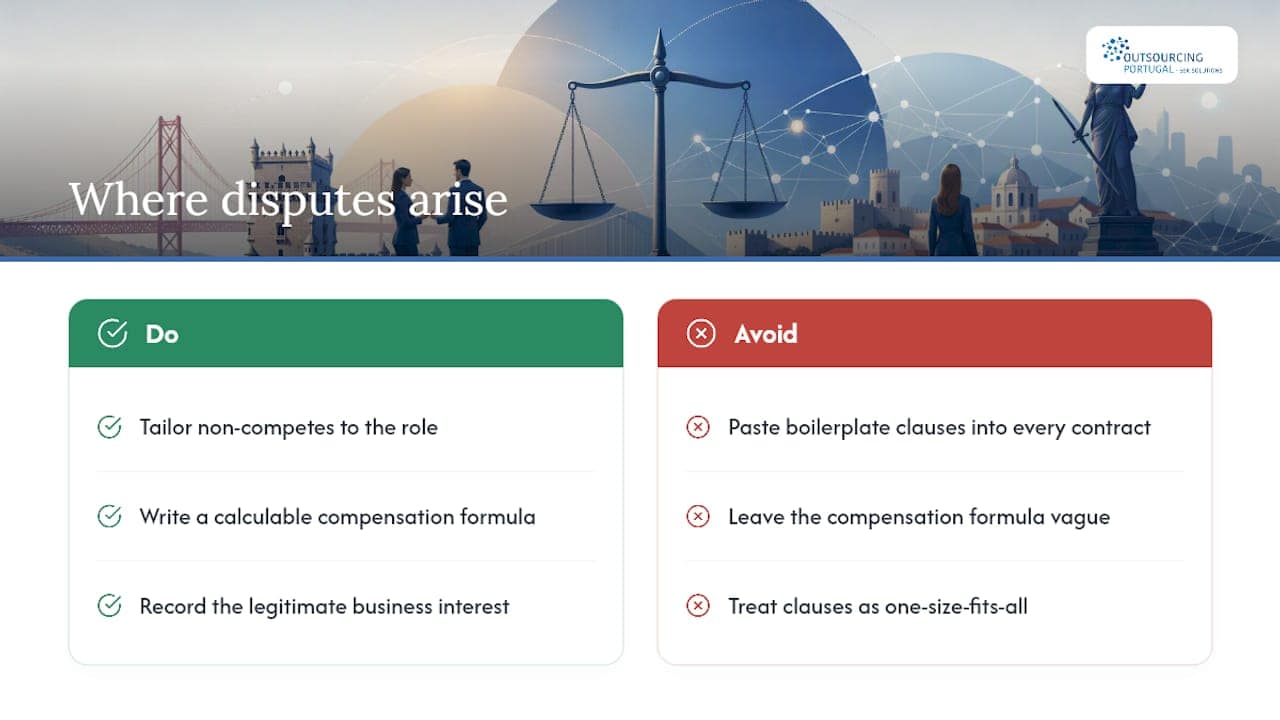
If I had to pick the single most underrated risk, it’s the boilerplate clause. Employers who paste the same non-compete into every senior contract, regardless of whether the role touches trade secrets or just processes invoices, are building clauses that courts have shown little patience for. Tailoring costs an extra hour of drafting. Litigation over a null clause costs a lot more, and the employer usually loses the compensation it already paid on top of the argument.
For employees, the priority isn’t negotiating a bigger number. It’s making sure the formula behind that number is written down in terms a court could actually apply.
— Paulo
Key Takeaways
A non-compete clause in Portugal survives judicial review only when it pairs a narrowly tailored scope with compensation that’s written in objective, calculable terms.
| Point | Details |
|---|---|
| Three conditions, no exceptions | Written form, demonstrable risk of prejudice, and determinable compensation must all be present. |
| Duration caps are strict | Two years is standard; three years applies only to roles with special trust or sensitive information. |
| Vague compensation is the top failure point | Courts annul clauses that promise pay without objective criteria to calculate it. |
| Illicit dismissal changes the math | Compensation can rise to full base salary if the employer is at fault for ending the contract. |
| Scope must match business reality | Nationwide or sector-wide bans get reduced or struck down when the employer’s footprint is local. |
This article is general information, not a substitute for advice from a qualified lawyer. Consult a qualified legal professional about your own circumstances before acting on anything here.
Sources
- Artigo 136.º – Pacto de não concorrência – o informador fiscal
- Acórdão do Tribunal da Relação do Porto (DGSI entry)
- Pactos de não concorrência e pactos de permanência no direito do trabalho português: função, limites e regime de validade – PMCG